Intro
The future will be defined by embracing the new highest leverage technologies. Throughout history, humans have won in their niche by leveraging technology better than their competition whether that comes from other humans, animals, or the environment itself. Not embracing critical technologies like gunpowder was life or death. The technology changes but human nature remains constant. As time marches forward, the risk of being left behind increases because technology compounds its growth. Every innovation comes faster and the sum of those innovations becomes much more powerful. Progressing in and adapting to society mandates a complex thoughtful approach to new innovations. Tech must not only be embraced, but also properly rejected.
How to Use Technology and Progress
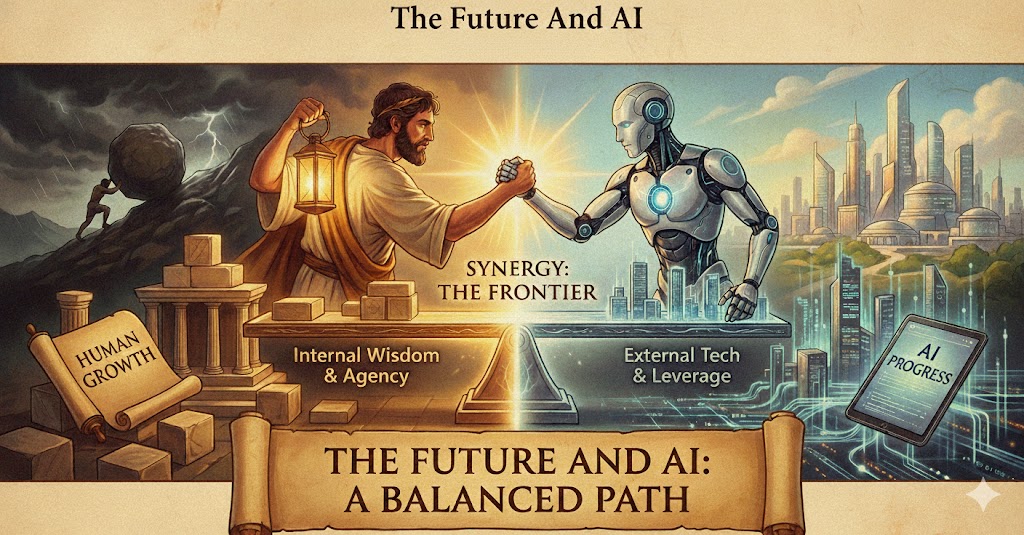
Thoughtless use of technology is as destructive to yourself as thoughtful use of technology is powerful. The only path to growth is pairing increasing technical knowledge with personal growth and improvements. It’s not about just using the tech available, but making ourselves the best possible entities. Upgrades in societal hardware must come with equal and opposite upgrades into the internal hardware of our minds. We must never lose sight of the fact that we bring technology into our lives to improve that life, but all too often we enslave ourselves through our own creation. Happiness and success lies in the proper calibration of our sacred internal hardware and balanced with knowledge of external hardware to position ourselves best to live any life we want. Maximum optionality. We must exist at the frontier of technological knowledge and personal growth. Life is balance. Externals and internals are incomplete on their own. Together they synergize to become more than the sum of their parts.
While true mastery lies at the midpoint of externals and internals, both are moving targets. We are constantly growing. Older, wiser, and more frail. Gaining wisdom and losing time. Technology has the opposite path, but with a reinforcing loop. The inevitable forward march of technology consistently redefines what is considered uniquely human. Humans must adapt and evolve with technology. Growth is never linear. While humans general become older and wiser and tech improves with time neither of these are guaranteed. Progress is never a given but only the result of hard work and diligent application.
Tech advancement is not a guarantee or assumption. Progress is the product of continued hard work within the right system with the right incentive structures. The future is scary, but we can shape it as well as embrace it. There are a variety of ways to view the world, but at its core there is a right way. We are always presented with a bit of a Pascal's Wager with our outlook. We must bet on an optimistic future defined by agency. A better world because we make it better. The probability of that future almost does not matter because it is the only EV positive mindset anyways. No other bet is worthwhile because we would be powerless to act in those futures. Nothing we do would matter. We would be Sisyphus trying to find pointless meaning in pushing that rock uphill. Living in a human daycare.
We're Trapped but that's a Positive
The bad news is we are trapped. Forced to be positive. The good news is freedom exists within constraints. The best and happiest moments of our lives have come because we have chosen to do one very specific thing in that moment. Often committing intensely. Happiness is not a result of having the most options, but choosing the right one and committing to it. We are out of options, but the one option we do have is pretty great. Our only option is to assume technology will continue to advance and prepare ourselves for a world where we have the ability to shape our lives and society in that unknown future state. There is genuinely no reason to believe anything else. Everything else is a losing bet. We need to accept that what we do matters even if it may not. We must actively create the positive future we want to live in. Even if we cannot. Even if we are lying to ourselves. In the absurd meaninglessness of that lie, maybe we can find meaning. The only way to prepare ourselves the future is to accept it’s already here and live like we are in it. Live like what we do matters even if we cannot prove it does. When we live with this level of paranoid techno optimism, we position ourselves best for the probabilistic future that is unknown and unknowable.
The next question is why is this our only option. Surely, we have at least one more. While the future is unknown and unknowable, the range of outcomes we as average people can plan for are much more finite. We cannot plan for a zombie apocalypse. We cannot worry about the incredible downside scenarios because the actions that would need to be taken are out of our control at the moment. We cannot paralyze ourselves with future states out of our control. Living according to things outside your control is guaranteed failure. We may become lucky enough to be making those decisions one day, but why prep for a destroyed world where no one wants to live anyways. Why prep for AIs taking over and taking all our agency away. If that happens, were hosed no matter what. Focus on what we can control. The possible future we can shape. Remain optimistic. We need to focus on the thoughts that serve us and the actions that benefit us. Planning for the unplannable is bad planning. The world rarely blows up. Change is a more gradual process than we imagine. That means its already cemented before we realize it’s happening. When the change becomes obvious to everyone, you are already years behind. You have little chance to adapt to the changed world after the fact. You must live in the future now to have a chance to succeed in that future.
Throughout history, the successful people have benefited most from living in the future. Jeff Bezos built Amazon before the dot com bubble. Then through building his low margin logistic heavy online book store did he discover the importance of cloud computing. AWS is now the powerhouse of the business, but it was an accidental discovery from the main business, which was itself early to the main tailwind. John D Rockefeller built Standard Oil into the dominant player in the industry when gas was just a useless byproduct of the heating oil that was central to his original business. Rockefeller went from competing with whale blubber to powering a transportation revolution through positioning and daring to see the future. Only by being well positioned for the future are we able to adapt to unknown emergent outcomes of the technological revolution that is to come.
What is the future?
So now the question is what is the future I should be preparing for. The answer is never clear. Hindsight offers nagging regrets of illusory clarity. Nuclear power seemed to be the future of energy, but in 2023 the US got as much energy from coal as nuclear power. Regulatory barriers led to lower funding and higher hurdles that stunted the growth and development of the better alternative. No matter how obvious the future may appear the outcome is never as justifiable and linear as we think. All this aside, AI is the most obvious future given the investment and broad based corporate and government support. The growth trajectory and arms race in AI point towards its continued importance in the world. So much could stop this. Investment could stop. Progress could halt. Regulation could kill it. Still, this appears to be something more important in the future than it is now. This does not mean we need super intelligent AI for AI to become more integrated into our life. Computers did not take over the world in a literal sense, but computing experts and the use of computers have shaped the world since the breaking of enigma in WW2.
Understanding how to leverage the key technology of the future is how you position for success. AI is a likely future, so we need to make AI part of us. We need to be AI native, but remember AI is merely a tool in our tool belt (until Skynet is launched in prod). The most successful technologists have been the best analog thinkers as well. Facebook did not become dominant because Mark Zuckerberg was the best at writing code, but because he understood he needed to hire the right people. Market his product well. Acquire the right companies and use psychology and design thinking to drive ad revenue (by manipulating our human hardware for his gain). John Carmack was an incredible programmer. His innovations created gaming graphics well ahead of his time, but no one would have played those games if they weren't fun. While we need to learn as much as we can about the most relevant innovative next wave technologies we must double down on analog learning. We must develop a deep knowledge of human nature and the world. Knowing a lot about technology or human nature will make you successful, but true step change power comes from the combination and mastery of both.
The Real Issue with the AI Revolution
My biggest fear about the AI revolution is that it outsources all thinking so we never learn. AI can easily outsource critical thinking and important learning. We can think that getting the summaries and take aways from a book in Chat GPT gives us equal value as reading the thing ourselves, but this could not be further from the truth. Most of learning requires us to wrestle with the ideas. To think for ourselves and develop our own conclusions then test those against other’s thoughts and the world.
Sure, knowing information has never been less important, but synthesis and critical thinking has never been more important. Those skills are only built through hard earned study not outsourcing thinking. Learning these key skills and then combining them with technological tools is what will truly lead to success. We must shape our minds to prepare for this new world. All technology has been the proper interplay between man and machine and this will be no different. Knowing how to use these new technologies and when is the key to success and that will only be the result of deep understanding and study in this area. When we drive cars, sometimes we need to go 20 mph and other times 80. Often, we need to get out of the car to understand where we are going. This will be the same with AI. Some tasks that are either manual or so far outside our circle of competence will rely heavily on AI, but other tasks will require significant human input and partnership. Still nothing will replace getting out of the car and giving someone a hug. Giving genuine love and companionship to another human. Only by shaping our own mental hardware can we get the most out of the advancements in technology.
We are Implementing AI Wrong
The immediate and obvious next step for AI implementation is to take away the nonsense and menial work done by younger people in training roles. This may make a company more efficient, but fragile to the future. Earning dollars today, but in 10 years they will have no one trained to do the job of directing the AIs and running the teams because those people were never given a chance to come up the curve. New hires are an unproductive labor suck that are often not justifiable financially in this new age of AI, but long term this could not be more different. This is the equivalent of not playing tee ball because you’re not as talented as the major leaguers. Everyone needs to come up the curve to be great. Being “more efficient” with AI might as well be saying we are closing the company in 10-15 years but were going out in a blaze of glory until then.
This is the long/ short term incentive misalignment that has plagued businesses and led to the current outsourcing in key capabilities overseas. Now though we are not outsourcing our critical manufacturing, but an entire generation of labor. We can’t leave kids behind; George Bush knew that. Success in the next few years will come at the cost of decades of stagnation. Younger people for their piece cannot become AI slop automata. The onus is on both the leaders to give people continued chances to build for the future and the young to focus not on getting the job in front of them done in the quickest way possible, but learning the critical skills that build their brains to be more robust for the future.
Hiring young unproductive people is still important because younger people are closer to the metal and further from the dogma. They have a clearer picture of what the future may look like without being biased to the current state of the world. They are blessed with the ignorance of youth as much as cursed by it. They have the most complete picture of the current tech world and the least bias and lock into the current world alignment. Growth creates uncertainty which creates opportunity. Young people succeed due to growth. Growth requires change, so young people need continue to change to progress. This is why young people must embrace new tech because they have no other choice, but companies must embrace young people to truly live on the edge and plant the seeds of tomorrows success. The masters of the old tech are already in charge and there is only one road to success inventing and embracing the new.
Conclusion
We are blessed and cursed to live in a time of great opportunity and risk, but all times pose the same trade off. AI is the next stage of human evolution, but we must not leave behind humans. Our future is defined by training the next generation and embracing the short-term inefficiency. People must also shape their brains and upgrade their internal hardware. Most importantly we must bet on our own agency and be actively optimistic. We do not know what is ahead, but it surely will be the ride of a lifetime.